Showing posts with label Havsanemon. Show all posts

Thursday, 4 July 2024

Moss 28/6-30/6 2024, Dive trip across the border

Hi and ho!

This time around, I went on a longer dive trip over the weekend with my dive club, the destination was to be the area around Moss in Norway, a short distance from the Swedish border, 3 whole days of diving (was the plan).

European lobster doing european lobster things

Dive 1: Heyerdalsbukta (i think) 28/6 2024

Depth: 16.2 m, Time: 55 min, Temp: 13 C

The first dive of the trip, on the same day we arrived to the camping spot and had unloaded our things into the cabins. The divesite was close to our accommodation, and of hard bottom type, there was also a wreck of a margarine carrying boat somewhere close to shore. Either way, a team first went down into the water to check the visibility and current, they reported little current but bad visibility, so the rest of us decided to do this as well. The walking in was a bit hard due to waves and slippery rocks, but we managed to do it somehow. As me and my buddy descended, we found out that the visibility was indeed very bad, but also that further down, there was quite severe current to be had, but we kept trudging on, the current and visibility cleared up at about 9 m depth, after which, the dive was quite enjoyable. We followed the cliffs that went down in plateaus to about 15 m, where my buddy made a few signs i didn't quite understand, and that i mistook for something else, so i turned around the dive as we were also starting to near the 30 minutes mark. We swam back, not having found the wreck (due to another mistake on my side, i didn't quite get the compass heading right. Either way, we ended the dive at 55 minutes without too much hassle, though as the time was rather late, we also decided to not do a second dive on this day.

Bit unexpected to find Deep sea king crab this late in the season here

Dive 2: Kjøvangen brygge 29/6 2024 

Depth: 32 m, Time: 53 min, Temp: 9 C

On the second day, the original plan was to do boat dives, but as the weather had worsened, with strong winds from the south (a leading reason for the bad visibility), so we got one of the locals to recommend us a site for shore diving instead, turned out to be the site i went to last time i was in the neighbourhood, Kjøvangen brygge, a good spot indeed.

Me and my buddy was first in the water this time, we had the instruction to go down quickly and try to find the line leading down towards deeper parts. And we did just that, we found the line pretty quickly and started following it downwards. At about 12 m depth, we encountered the thermocline and the waters cleared up (that was a common thing along all the dives, the thermohalocline was the border between bad visibility and decent visibility). We soon got to the cliff walls present on this site and continued following them down to about 30 m. after which we made our way a bit more shallow. The highlight of this dive was for me us encountering a Deep sea king crab out of season, as they usually are not seen this time of the year in Gullmarn, but I guess Norway is different, even so close to the Swedish border as we were. Either way, after spending some time to photograph the crab, I signalled for us to turn around and head back. As we swam back, we did see quite a few lobsters out in the open. We ended the dive at 53 minutes, got up and onto the pier where we doffed our gear.

Norwegian Red Sea cucumber (Parastichopus tremulus) 

Dive 3: Hvitsten torg 29/6 2024

Depth: 22 m, Time: 45 min, Temp: 11 C

We headed to another site for the second dive of the day, another site i have dived before, this one was a few years ago though, during the "pre-covid" times. This time, i was a bit unsure of diving here, as the wind was blowing straight into the bay, giving rise to quite big swell, but nonetheless, we did our dive. And good was that! We swam out and started to descend, this time we were a group of 3, so it was a bit harder perhaps to keep up the contact between the divers, but we managed. At about 14 m depth, the waters cleared out and the visibility became much better. We followed the cliffs and slopes towards the right, we did end up a bit deeper than planned for this dive perhaps, as our max depth should have been 20m, but as seen, we got down to 22 m, so not too much of breaking the depth limit on this one. After a while we turned back, and as we swam over a rock jutting out, one of my buddies signalled for me to look at something, this something turned out to be a Striped Mullet, a fish we usually see late in the autumn on our sites, but there it was. So i did stay a bit and snapped a few photos before continuing. There was also a lot of lobsters on this site, didn't count, but at least 4 were seen as we swam along. We ended the dive at 45 minutes, got up in the swell and swam in towards land, got up and made ready to head back to our cabins.


Striped mullet, a fish you usually see late autumn in Lysekil

Dive 4: Fristranda 30/6 2024

Depth: 23 m,  Time: 51 min, Temp: 13 C

On the third day, we asked the local dive centre about some good shore diving places close by, preferably more southwards, so that we didn't have to drive for so long to get home afterwards. Said and done, we ended up on a spot called Fristranda with a nice sandy beach and a somewhat protected bay. We made our dive buddy pairs and headed out, I ended up with a newer diver, so i took it a bit more slowly and tried to keep more of an eye on them than i usual (tried being the operative wording here). Well either way, we swam out to a buoy before descending, as to have some sort of reference to make it easier for us, after getting visual contact with the bottom and finding our bearings, we began swimming to the right as we had been tipped off on regarding this site. After swimming a bit along a slope, we found a wall at about 14-15 m, which we then started following for the rest of the dive. Nothing of note was really happening on this dive, it was quite a simple and relaxing dive. After turning around and reaching the end point where we had our safety stop, I deployed my DSMB, waited out the safety stop, and then started to ascending. At the surface, my buddy had a bit of a issue as they had breathed down to about 10 bars, and thus weren't able to completely inflate their BCD, but that was easily fixed with a few breaths of oral inflation. But i guess that if i am to dive with newer people, i will have to tell them to show me when they have 50 bars left, because my buddy sure didn't show that. 


Edible sea urchin with a old tubeworm tube on top of it

Dive 5: Fristranda 30/6 2024

Depth: 26 m, Time: 51 min, Temp: 13 C

The last dive of the trip we made new pairs, as some people didn't want to do a 5th dive. So i ended up with the same buddy as i did on dive 2, and we decided to dive towards the left, to see what could be found there, said and done, we swam out to another buoy a bit further away before descending. We followed the slope downwards and to the left, and before long, we found rocks starting to jut out of the bottom, providing a nice hard substratum for things to settle on. We followed the rocky wall, looking and beholding the things, there is really not much of note happening to us either, and it was quite a nice and relaxing dive as well. We did get a bit lost, as the rocky walls did a turn towards the north in a way we didn't quite expect as we went, so we ended up surfacing a bit further out than we planned and had to do a bit of a surface swim back. We got up and doffed our gear, making ready to head home after a weekend of diving :)

All in all, it was a nice diving weekend, even if the visibility could have been better and not everything went to plan. Some new lessons were also learned :)

So until next time! Keep on swimming!


Horseman anemone (Urticina eques)

Friday, 14 June 2024

Jordfalls hamn 9/6 2024 Eh? is this thing still on?

Hi and ho!

Ok, it really has been a while, and not much diving has happened due to various reasons, and it seems like that will be continuing for a bit more.

Either way, managed to get a dive day during the weekend, so am quite satisfied with that, the spot was Jordfall marina, the go-to for easy but interesting diving. On this dive i also did some collecting of samples that i volunteered to do for a scientific study

Horseman anemone on a rocky outcropping
Dive 1: 

Depth 28 m, Time 54 min, Temp 9 C

Me and the buddy waded out into the bay as usual, our plan was to dive towards the right as there was a lot of people on the site on this day (a local dive centre having a small excursion there too). We had asked beforehand how the visibility was on this day (kind of windy), and had gotten the answer that above 15 m, the visibility was bad, while below, it was ok-ish. Said and done, we descended in line with the outer edge of the innermost jetty, and as it was said, the visibility was quite bad on the way down. 

Establishing visible contact with the bottom, we stopped up a bit and made sure that everything was a-ok before continuing on our merry way towards the right, following the soft sediment slope downwards. At about 18-20 m, the visibility cleared up a bit and actually got pretty decent, it was also around here where the thermocline sat, going from 15 C to about 9-10 C quite quickly (and one could feel that). We swam past anchoring blocks for the floating jetties, forests of Peacock feather-duster worms (Sabella pavonina) and huge fields of the soft bottom hydroid Corymorpha nutans. At about 25 m, we found a smaller area of rocky outcroppings, which had some of the hydroids i was ordered to sample (family Tubulariidae), so sampling was carried out with a little bit of shaking and swearing (those things really got stuck easily on our gloves). After doing the sampling things, we continued further. As we started to run lower on the NDL, we turned around and started swimming back, following the slope upwards. Soon after turning around, we came across another rocky outcropping that housed a huuuuge Horseman anemone (Urticina eques) with beautiful patterns, not the typical colouration though, a tad bit redder that one. At about 18 m depth on the way back, we encountered a field of tires and various pieces of trash, which i sort of marked in my log, so that we know the depth (because positioning underwater is next to impossible). As we got to our safety stop, the current had turned and was flowing outwards, which dragged all the lion's mane jellyfish out from the shallow waters and our way, so we spent the safety stop dodging and weaving from jellyfish stingers.

We ended the dive at 54 minutes, got up and made ready for a surface interval in the sun :)

Norwegian red sea cucumber (Parastichopus tremulus), a species that you usually see a bit deeper down


Dive 2:

Depth: 30 m, Time 40 min, Temp 10 C

After hanging out in the sun, we headed out once more to dive, this time, we planned to dive towards the left side, along the more common route of Jordfall marina. We descended and began following the slope outwards and to the left, soon hitting the "forest" of Tall Sea-pen that is present at around 25 and down in this area. We swam around a bit before it was time to start heading up, on about 24 m, we came across the rocky cliffs that goes down in a "stair steps" sort of way, forming plateaus at various depths, it was also here we found a large swath of Tubulariidae hydroids, where another sample was promptly taken. It was at this point that my NDL started to get real low, and we had to speed up our ascent a little. The NDL didn't quite clear either until we reached about 12 m.
Either way, we did our safety stop and ended our dive at 40 minutes, making it a little shorter than normal for the summer season.

All in all, it was nice to be back in the waters again for a proper dive

So until next time! Keep on swimming!


Spotted dragonet (Callionymus maculatus) on the soft sediment bottom


Monday, 15 May 2023

Jordfall 14/5 2023. Starting to warm up.

 Hi and ho!

This week, the weather has been really fine, with sunny skies and high temperatures, but as it is still early in the year, the sea has yet to warm up. That being said, it is starting to get slightly warmer right now, so one can maybe forgo the winter vest.

Devonshire cup coral

Dive 1:

Depth: 29 m, Time: 55 min, Temp: 7 C

We swam out to the end of the pier before we started to descend into the water column and downwards. As soon as we got visual contact with the bottom and got our bearings, we started to make our way towards the right side of Jordfall marina, as we had planned to, following the slope downwards as we went. 

We swam along, making way towards the right side, following the bottom and slope. There was really not much going on here on this day, the water was rather pleasant though. When we got to whereabout the unexplored cliff area, it was about time to turn around (We really need to explore this area more me thinks). We started making our way back, but as we were also relatively low on no-deco time, we also had to make our way more shallow a bit quickly. We ended the dive at 55 minutes, got up and doffed our gear, making ready for a surface interval in the sun.

Fireworks anemone up close and personal

Dive 2:

Depth: 30 m, Time: 40 min, Temp: 7 C

After having had a surface interval with drinks and some food, we made ready to head into the waters again. This time we decided that we were to head straight out and towards the left instead, trying to look for Fireworks anemones. We swam out until we were in line with the pier once more before we started to descend and swim outwards in a relatively good pace. After a while, at about 28 m depth, we came across one of the Fireworks anemones that is usually present on this side of Jordfall, as well as some "forests" of Tall sea pens. Due to having gone deep on the first dive as well, we had to turn around soon after this, as we were starting to run low on both air and no-deco time. We made our way back, following the the muddy slope upwards and back to the starting point, ending our dive at 40 minutes.

All in all, I can say that this was a good dive day, if maybe a bit on the boring side, as nothing out of the ordinary happened, but then again, i think i prefer days when nothing is happening :)

So until next time! Keep on swimming!

Orange brown aeolid out on the soft mud bottom.

Monday, 5 December 2022

Hällebäck 4/12 2022

 Hi and ho!

This week me and my buddies headed for Hällebäck together with some people from the Lindome dive club (a club my dive club has close connections with), the weather while a bit cloudy, was quite ok for this time of the year.

Fountain anemone (Sagartiogeton laceratus)

Dive 1:

Depth: 30 m, time: 48 min, temp: 10 C

Me and my buddy decided to do the first dive towards the left side of the dive site, as the right side is better when it is dark outside. The left side has a stair-like area of cliff shelves where it in the spring usually is good for finding king crabs, but as it is autumn, no king crabs, but instead other critters were present, such as hermit crabs, wrasse and sea anemones of different species. However, on this dive I somewhat struggled to find the balance in the water, which went on the whole dive really, just couldn't find the balance i usually got for this kind of thing. The shutter trigger for the camera housing was also acting up, so have to fix that too. Either way, got some ok photos on this dive. When we hit our margin time for No Deco Limit, we started to go more shallow, while also making our way back towards the start of the dive site. 

We surfaced at 48 minutes, got up and made ready for a surface interval with hot drinks.

Close up of a bobtail squid

Dive 2: 

Depths 23 m, time: 47 min, temp: 10 C

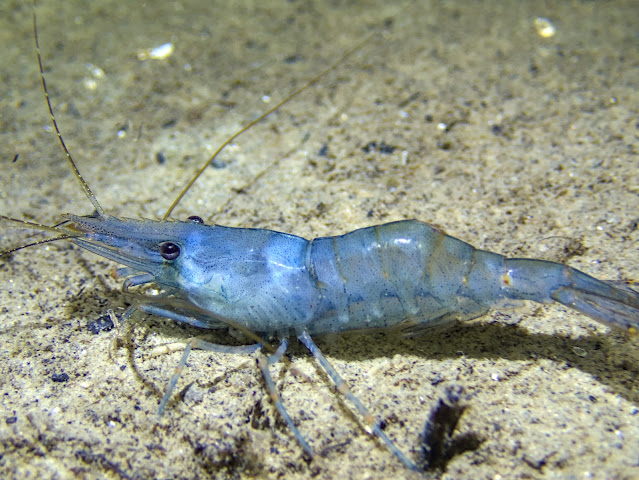
Once we had done a bit of a surface interval, and the sun had been down for a little bit, we once more headed out for a dive. This time, we were joined by another person from Lindome dive club, while my other buddy was making ready, me and the Lindome person discussed some plans and signs, as they most likely wanted to continue the dive when we were going to turn around, and as they are a experienced solo diver, that was OK with me. So, once my other buddy was ready to go, we swam out a little bit from the pier we jumped in from before starting to descend. We quickly descended to about 5-6 m and started following the bottom outwards, looking for squids. And at about 20 something meters, i do indeed spot one (the only one on this dive), so we stayed around it for a little bit (and it probably got annoyed with us). The rest of the dive was quite uneventful, and as me and my buddy signalled to turn around, the Lindome person signalled that they wanted to continue the dive on their own, so we just left them to their own devices, as we had discussed before. Me and my buddy swam along the slope, slightly upwards and to the left side. At about 8 m, I spotted a very blue coloured baltic prawn, which I of course had to photograph, and while the shutter trigger was still acting up, I got some decent photos of it.

Me and my buddy surfaced at 47 minutes, got up from the water and started to doff our gear making ready to head home again.

All in all, this was a very nice dive day, even if the waters in the surface are cold right now at 8 C (still warm by February standards though).


So until next time! Keep on swimming!

A very blue Baltic prawn (Palaemon adspersus)

Sunday, 25 September 2022

Släggö 24/9 2022 Easy diving to ease the mind

 Hi and ho!

This weekend we once again went to Släggö once again, just to have something easy to dive. The forecast told of rainy weather, but as always, there was little to no rain in Släggö (though it had most likely recently rained by the look of it).


Eelgrass anemones on a piece of eelgrass

Dive 1:

Depth: 25 m, Time: 69 min, Temp: 15 C

We swam out a bit to get closer to the cliffs before we started descending, as we did so, the seemingly good visibility on the surface did soon disappear, though it was still better than it has been recently, somewhat. I was also using my new suit, that i haven't quite gotten used to yet, which also made this dive a bit more of me concentrating on getting the balance right with my stuff. Either way, there was some stuff to see, a lot of European lobsters for example, there was a lot active on the site on this day, but as they were mainly hiding in crevices and underneath rocks, there weren't many that was good for photos.

We surfaced at 69 minutes, got up and doffed our gear, making ready for a longer surface intervall, as we had planned for night diving this day as well.


North sea Cerianthid, but this one has quite short arms

Dive 2: 

Depth: 14 m, Time: 66 min, Temp: 15 C

After a surface interval, we started making ready to head out once the sun had set, wanting to do a night dive and look for squid as the season is upon us. Well, we jumped in right before it got proper dark and descended soon after. On this dive, no squids were found, meaning that they haven't quite made their way into the bay proper, instead there was a lot of gobies about, as well as pipefish of different kinds. After about 30 minutes, i made the signal to turn around and swim back towards the starting point. 

As we neared the point were we went up, my buddy signalled me to come and look at something, turns out that something was a small eel, not something you see every day indeed. Either way, after photographing it for a bit, we continued forward and soon after started to ascend to the surface, thus ending the dive at 66 minutes.

All in all, it was a nice dive day for sure, even if it is starting to become "hot chocolate" weather :)


So until next time! Keep on swimming!


An eel!

Monday, 6 December 2021

Dive trip 3/12- 5/12 2021. Club excursion to the "polar region".

 Hi and ho!

This weekend, the dive club had their yearly winter excursion to Lysekil, combining it with the last parts of the CMAS** course we've had during the autumn. The weather was clear but windy, which in combination of damp ocean air and minus degrees temperatures was really cold if i have to be totally honest. like really freaking cold even. But regardless, we still went diving :)


Rock gunnel (Pholis gunnelus) hiding in the algae on the bottom

Dive 1:

Depth: 18 m, Time 25 min, Temp: 6 C

After some retakes due to insufficient weighting, somewhat leaky drysuit (not mine this time) and other stuff, we started descending quite close to the pier in Släggö, We began swimming outwards, following the sloping downwards. I have to admit that i did get a bit lost and we went a bit too diagonal to reach the usual spots of Släggö, instead we swam out over the soft bottom slope where one usually finds squids during night dives. But as it was daytime, no squids to be seen. Not much of note on this dive. But as we neared the 10 m mark, my buddy started corking, i tried to turn them around and get their  gas out of their suit, but that proved unsuccessful and i had to let them cork while i quickly ascended to the surface to make sure they were ok, which they were. We then swam back to the starting point and got up from the water. When we got up, my buddy told me they were soaking wet, which is less than ideal when it is sub zero temperatures in the air as well as quite windy.

Small frilled anemone on the side of a sunken rowboat
Dive 2:

Depth: 20 m, Time: 50 min, Temp: 6 C.

After lunch and some time to rest, it was time for the night dive part of the course, and of course the other non-course participants like me were doing a night dive as well, no way we were gonna miss this. Well, my previous buddy didn't participate due to their suit being sopping wet and that we discovered that there were holes in the arm seals (and the neck seals was extremely bad too, the dive centre really shouldn't have even had this one out for renting i feel). So i dived with another group instead on this dive. We entered the waters and descended almost immediately in order to look for the lumpsucker that has set up shop. We didn't see it this dive, but alas, tis fine, I've seen it quite a few times already. We started swimming diagonally across the bottom, heading towards the area where one usually can see the squids. At about 18 m, we encountered the thermocline, which was really quite deep down this time. Here it was about 10 C, but as we didn't stay for too long either, we didn't get to enjoy it for quite as long. After turning around and swimming back for a little bit, i noticed a small shape on the bottom, finally, a squid! So of course i had to stay a little bit and photograph the critter. As i was photographing, some of the other dive pairs came up to us to look at the little squid. We swam back and surfaced at 50 minutes, got up and started loading our gear into the car, preparing to go back to the hotel.

The squid!
Dive 3: 

Depth: 12 m, Time: 30 min, Temp: 6 C

On the second day of diving, we first went to Släggö once more for some of the last course stuff, and to just have a nice easy dive after breakfast. I paired up with my buddy from yesterday and we jumped into the water in short order. We quickly descended after that and almost immediately found the lumpsucker hanging out. Unfortunately, i had forgotten to remove the camera cover, so no photos of the lumpsucker this time, as i had to faff about with removing the lens cover underwater, with drygloves on (i managed to do that, but by then the lumpsucker had moved away) Well either way, we continued for a bit more along the bottom, following the line and the slope. While my buddy did have some issues with buoyancy and trim, they did sometimes lie really beautifully in the waters :)

Well either way, at about 12 m, i sort of felt that we shouldn't go deeper, as my buddy was flailing around quite severely right there and then. So i signalled that we were to turn around, which was probably for the best. We swam back in orderly fashion and i once again got a bit lost on the way back. But it wasn't too badly off course from the pier. We surfaced at 30 min and got up, my buddy said they had been leaking from the neck all dive, so they quickly got into cover to change into dry clothes, as it was still rather windy here.


Dahlia anemone with very clear banding

Dive 4:

Depth: 27 m Time: 51 min. Temp: 10 C

After packing up our things and heading out from the hotel, some of us decided that we were to do a last dive in Skår, the dive site close to the ferry terminal in Gullmarsfjorden. 

Me and my buddy descended quickly as soon as i felt it was deep enough, we soon found the dropp off and followed the wall closely, trying to get to the thermocline as soon as possible. The thermocline was found at about 14 m depth this time, which was quite shallow compared to the thermocline the evening before. Well, either way, we continued following the wall downwards. After about 25 minutes, i made signal  to turn around, as we had to swim back too after all. So we turned around and started to head back. As we neared the end of the dive, i spot a small shape on the sand bottom, turned out to be a sand shrimp, which promptly dug itself down into the sand as soon as i got close, but i managed to snap a few photos before it completely burrowed down. We surfaced at 51 minutes, and it was cold in the surface, so we quickly got up and started to doff our gear. Making ready to get home.


All in all, It was a nice dive trip :)

So until next time! Keep on swimming!


Sand shrimp (Crangon crangon) peeking out of the sand


Thursday, 23 September 2021

15/9-18/9 2021. A trip to Flekkefjord, Norway with Chalmers diving club.

 Hi and ho!

Now that our dear neighbour to the west, Norway, has opened their border after a year of plague and uncertainty, my club decided that now was a good time to take up the tradition of doing a longer dive trip to Norway, as the diving there is in a completely different class compared to Sweden. Said and done, the destination of the trip was decided to be Flekkefjord on the south western coast of Norway, reasonably far away from home. There is also a historical wreck there, the wreck of Gudrun, a WW2 ship that is located just outside of Flekkefjord.


Urticina eques, a beautiful anemone closely related to the Dahlia anemone (and hard to differentiate)


Dive 1: Gudrun 1

Depth: 35 m, Time: 46 min, Temp 17 C

We anchored the boat onto the float that marks the position of the wreck of Gudrun. Decided upon dive pairs and headed off into the waters. All divers descended following the rope in quite the quick fashion as a group, almost too quick really as i got some problems with equalizing at 18 m and had to stop for a little bit to clear it, but as soon as that was done we kept going. Gudrun herself came into view at about 20 m, meaning that there was about 7 m visibility straight down on this day. We came down on the rear of the wreck and all swam up to the big steering wheel in order to get the obligatory photos while posing with it. After photos were snapped, we split up into the decided buddy pairs and me and my buddy began swimming around the wreck, looking at the rudder, propeller and all the other things she had to offer. As Gudrun lies quite deep, me and my buddy didn't have that much time on her, even with the best gas mix for the depth we were on. So after a little while, we started to run low on time before deco, so we started swimming back to the rope in the rear and started ascending along it. In order to stretch out the dive as much as possible, I decided to ascend as slowly as humanly possible (and so i could try and photograph the critters on the rope too) As we were slowly making our way up, we started to see the second dive pair further down underneath us, but soon they also were at about the same depth as us at the safety stop. We surfaced at 46 minutes, got up in the boat and got ready for surface interval.


Star ascidian (Botryllus schlosseri), a colonial sea squirt

Dive 2: Torsøy

Depth: 10 m, Time: 65 min, Temp 17 C

The second dive of the day was decided to be closer to the Flekkefjord dive club house, as we had gotten out pretty late, nonetheless, we found a small bay relatively close to the starting point, parked the boat and got into the water. Here the bottom was quite similar to the type i am used to, muddy, with lots of smaller fish and decaying algae. Honestly this was quite a boring dive site, but nonetheless, me and my buddy kept swimming around. We surfaced at 65 minutes, got back into the boat about at the same time as the others, and drove home to the diving club house.


European painted top shell (Calliostoma zizyphinum)


Dive 3: Saueholmene

Depth: 28 m, Time: 62 min, Temp 17 C

We headed out to the outer parts of the archipelago, the weather was perfect, almost too perfect, with almost no waves out in the open and the sun shining brightly. We rolled into the water from the boat close to a cliff wall, swam closer by and started descending as soon as everyone was ready. When we descended, we discovered that this area was an area with plateau's on different levels and waving kelp forests. Though honestly i didn't get to enjoy it quite as much as my dive buddies kept swimming on like they were on some kind of schedule, or torpedoes trying to sink a boat or something. Either way, i was pretty ticked off by the time we ended the dive. Well, there was some pretty large fishes, mainly saithe swimming around in the kelp forest, which my buddies tried to hunt, but to no avail. We swam around for a while before we ascended to the surface, looking at the vibrant kelp forests and marine life.

We surfaced at 62 minutes, got into the boat and got ready to have a surface interval. while the other group did their dive.


Polymastia boletiformis A type of sponge.


Dive 4: Hunden

Depth: 23 m, Time: 39 min, Temp 17 C

After a surface interval we went to a place the other group had dived the day before, a small rock called Hunden (meaning "the dog") that jutted up right outside a bigger island. From the day before we knew this was an area where you could find and pick scallops. So we did some shifting around in the dive pairs and headed off into the water as the first dive pair. We swam on the surface until we got close enough to the small island that is Hunden. before we started to descend. The visibility on this dive was pretty ok still, though there was some particles in the water here. As we swam along, one of my buddies signal me to look at something, after looking a little bit, i realize it is a small Monkfish that is hiding in the sand. So i of course went up to it and started snapping photos for a bit. After i was done, we continued along the cliff and started to head a bit downwards. As we swam along the cliff wall, i was photographing some sponges when i spot a very pretty sea anemone a bit further away, when i get closer, i see that it is a Horseman anemone, and a beautiful one at that. So i excitedly began photographing it before letting the others close to it (as it usually is with me and photographing)

It was around here one of my buddies started to signal that they were running low on gas, so we began ascending shortly afterwards. At the safety stop, the first buddy tried to shoot their SMB, but the line had somehow gotten tangled, so i got to do it instead, this time it went pretty well :)

We surfaced at 39 minutes and swam back to the boat


European monkfish (Lophius piscatorius), though a very small specimen

Dive 5: Gudrun

Depth: 34 m, Time: 31 min, Temp 17 C

Once again we decided to do a dive on Gudrun, this time however, me and my buddy knew we had much less time on the wreck due to not being able to fill nitrox. We rolled into the water and quickly descended along the rope. down to the rear of the wreck. This time both me and my buddy got photographed with the big steering wheel, even though the photo of me did end up blurrier than the rest, oh well. After getting our photos snapped, one in the other buddy pair spotted a sizeable Lumpsucker in a crevide on the wreck, so i spent some time photographing that one before we split off from the other pair for our own dive. Me and my buddy swam around the rear of the wreck for a bit, even dipping down to the propeller before it was time to swim back along the surface line as we were running low on no deco time. We ascended slowly along the line and surfaced at 31 minutes. Got back into the boat and doffed our gear, getting ready for a surface interval with lunch.

Lumpsucker (Cyclopterus lumpus) trying to hide away from the camera (and the camera man)


Dive 6: Kålesundet

Depth: 30 m, Time: 28 min, Temp 17 C

The last dive of the trip was to a "unknown" 1700s wreck where there were some really large cannons spread out in the area. But as the exact position was unknown to us, we looked through the sea maps and position data on the internet and buoyed a spot where we thought was "appropriate" for this dive. Me and my buddy were the first pair in the water, we followed the buoy line downwards, but sort of lost it at 15 m depht due to various stuff, we did find it quite soon afterwards either way when we got a bit deeper. When we found the line again, we started seeing weird shapes a bit further way, when we swam closer, we realized that "holy guacamole! these be the cannons!" So we had managed to buoy the spot almost perfectly, we thus swam along the bottom looking at the cannons of the wreck, where they lay on the bottom, some being stuck in a upright position, others laying flat on the bottom among the rocks. At one, my buddy waved at me to come and look at something, that something turned out to be a medium sized lobster hiding underneath the cannon. I of course spent some time photographing it as i usually do. When i was done we continued on, albeit in the opposite direction, and soon afterwards, my buddy signalled that they were running low on gas. As we started to ascend, i realized there was quite the current going at about 10 m depth, so we were swept along for a bit. We surfaced at 28 minutes and got back into the boat in a orderly fashion, doffed our gear and got ready to be on boat watch as the other divers went diving (this was an area where we couldn't anchor).

All in all, it was a super nice dive trip, with almost perfect conditions.

So until next time! Keep on swimming!


Opening to one of the 1700s cannons on the bottom, this was the first of many.


Monday, 6 September 2021

Fossen 4/9 2021, Gear troubles, diver bubbles.

 Hi and ho!

This weekend me and my dive buddy went to the Fossen camping dive spot, something that has become a bit of a regular occurrence now. The weather was nice, unexpectedly nice actually, as the forecast had told of clouds with a risk of rain, but no it was sunny the whole time while we were diving. 

When we were setting up the gear, the first trouble occurred. I had recently changed to longhose on my primary regulator, this was to be the first time i was to use it. When pressurizing the setup, I realize that there is a leak somewhere where the hose connects to the reg, after a bit of unscrewing and fixing around, I come to the conclusion  that the O-ring inside the hose is broken and need to be changed. What a perfect day to forget the save a dive kit with stuff like that back home, right? Either way, there is a dive center in the area, so that was quickly fixed, and we began heading out into the water. As we did this, I realized i had forgotten to attach my inflator hose to the drysuit, so we fixed that quickly, while also disentangling my backup regulator, as that had gotten tangled as well. After that, we finally could start descending.


The tube feets and spines of a Common sea urchin

Dive 1: 

Depth: 27 m, Time 52 minutes, Temp 18 C

As we descended, my buddy got some problems with their mask filling up with water, so we aborted the descent and fixed around the mask a little bit on the surface, making sure that it didn't go over the hood, after this was fixed, we once again started descending, this time it went much better, but as I trimmed out, I realized that the hose to the backup regulator was sliding over my head, so I spent the dive shoving it behind my head every now and then. As we descended i also spotted a shape a bit off in the distance, with a closer look I saw that it was a somewhat sizeable Lion's mane jellyfish. After snapping a few photos and then ducking out of the way, we continued following the slope until we found the drop-off. At the drop-off we followed the wall descending for a bit before starting to swim to the right. After a while, it was time to turn around, so we ascended to somewhat shallower depth and started swimming back towards the starting point. We surfaced at 52 minutes, got up, doffed our gear and got ready for a nice surface interval in the sun.


Nice closeup of a Dahlia anemone 

Dive 2:

Depth: 26 m, Time: 55 min, Temp: 18 C

After a surface interval with snacks and sun, it was once again time to head into the water. This time I had more control on my stuff and thus didn't encounter any problems. As we were to descend, my buddy suddenly lost one of their weight pockets, so I had to go down and look for it. After searching around for a bit, I found it and brought it up to the surface. After re-attaching the weight pocket to my buddy's BCD and making sure it was well attached, we once again swam out into the bay. This time we headed to the left side of the bay, as we never really dive on that side. We descended without a hitch and started following the slope diagonally to the left and downwards. After a little while, we came across a drop-off and cliff walls. The cliff wall itself was quite covered with animals such as anemones and tube dwelling marine worms, almost like the big wall in Ormestad. As we were swimming along the wall, I spotted something small and white, with a closer look, I saw that it was a Candy striped flatworm, a beautiful little critter that looks a bit like a nudibranch. After staying and photographing it for a bit, it was time to turn around the dive. We surfaced at 55 minutes, got up, doffed our gear and started getting ready for heading home.

All in all, in spite of the somewhat chaotic beginning of both dives, it was a super nice dive day, even if the visibility was less than ideal in the deeper waters, lots of particles in the water.

So until next time! Keep on swimming!


Candy striped flatworm (Prostheceraeus vittatus) looks like a nudibranch, but is not at all closely related.

Monday, 2 August 2021

Skår 31/7 2021- Drills and learning experiences.

 Hi and ho!

This weekend we went to the dive site Skår, which is close to the ferry over the fjord, and one of our outermost dive spots in Gullmarsfjorden. This day the plan was to do some exercises at the end of the dives, and maybe some during the dives. So after getting the gear out of the cars, and kitting up, we divided into dive pairs, made our plans, and headed out for the first dive.

Orange brown aeolid crawling along the silt of the bottom.

Dive 1:

Depth: 27 m, Time: 57 minutes, Temp: 17 C

We descended almost immediately, following the slope downwards, while descending, i tried another way of equalizing the ears, which worked somewhat well, gotta practice that more. The visibility was not too bad this day, a bit of particles in the water, but not the worst I've seen. The water temperature was almost disgustingly warm, with the thermocline at about 20 m depth. Several haloclines could be observed, though not as clearly as some other places, being more like a haze at certain depths.

We swam about for a bit before turning around and swimming back. As we had planned earlier, we deployed the surface marker buoys from 12 m in order to train for free water ascent, though I had to wait until we reached about 7 m, as my line was that long at maximum. So we deployed our buoys, and started ascending slowly, just hanging in the lines. It took some effort to deploy the buoy, so that is something I need to work on too.

We surfaced at 57 minutes, got up and doffed the gear at the site, preparing for a nice surface interval.


Once again, a beautiful Dahlia anemone, one of the prettiest sea anemones out there.

Dive 2:

Depth: 27 m, Time: 58 minutes, Temp: 17 C

After a surface intervall, with some food, and also some rain, we once again headed out in the water. This time, we decided to keep a bit closer to the second dive group, as one of the divers had felt a bit nauseous on the previous dive, so in case they needed to thumb the dive, their buddy would have a secondary buddy from our pair. Either way, we descended together with the other group, but soon it became clear that they were doing ok, so we left them be and continued on our way. On this dive, many Rock gunnels were out and about, unfortunately, they weren't very keen to be photographed, so I didn't get any photos of them. We continued for a bit before it was time to turn around once more. Like the dive before, we deployed the surface marker buoys at 12 m (7 m for me) to drill both free water ascent and deploying buoy. This time, it went a bit better, but still need to work on that. We surfaced at 58 minutes, got up and ended the dives for the day.

All in all, it was a nice dive day, and I clearly need to work on some skills and drills. Oh well.

So until next time! Keep on swimming!


The zoantharian Isozoanthus sulcatus, a small colonial cnidarian

Monday, 7 September 2020

Ormestad 5/9 2020. Into the abyss and back again.

Sealoch anemone, a closer look :)

Hi and ho!

This weekend me and my buddies went to Ormestad and the great walls that can be found there. This time around, we had gathered quite a sizable number of people that wanted to go diving. a whole 9 people, including an instructor of mine. So we got to Ormestad, picked the gear out of the car (after I accidentally bumped into a log, managed to scrape off some paint off the car), carried it to the jetty at the shore, divided into dive pairs and got ready to head out into the water.

The great wall of Ormestad, covered in various organisms


Dive 1: 
Depth: 35 m, Time: 60 min Temp: 16 °C

I paired up with my buddy, and planed to go quite deep this first dive, we got into the water, swam out to the wall and descended when we realized that the winds were not favourable. We descended in a orderly fashion straight down towards the abyss. As we descended, we felt that there was a current going outwards from 15 m to about 30 m. So we got carried by the current while descending for quite a bit. While I was photographing some other stuff, my buddy signalled to me to come and look at something, so I came over, and lo and behold, a Plated squat lobster, the first I've ever seen of this species. So i spent a minute trying to photograph that one. After a while, we started nearing deco, so we started to ascend a bit in order to go into deco. As I hit turning pressure I signaled to my buddy and we began swimming back, Not much occurred on the swim back really, saw some lobsters hiding among the rubble and in the crevices of the cliff. As we were laying on the safety stop, my buddy and I decided to shoot some SMB, as it is good to train for real situations. said and done, we both launched our buoys and started ascending as we retrieved the lines for the buoys. As we did this, my buddy got a lion's mane jellyfish right in their face, and promptly dropped their double-ender which I saw and retrieved immediately. As we got up, we took off our gear and enjoyed our surface intervall with food and drinks.

The plated squat lobster (Munida rugosa), hiding in a crevice

Dive 2:
Depth: 28m, Time: 59 min. Temp: 16 °C

After a nice surface intervall with food, drinks and chatting, we prepared to go into the water once more. This time we did a bit of a switch between the pairs, me and my buddy got a newer diver with us as their previous buddy wanted to do another kind of dive. We planned to do another dive at the wall, this time a bit shallower though. As we got there, it became clear that the newer diver was having problems, too much weight, and he could not stay afloat, thus we had to abort the dive and get him to the surface so he could end the dive. When we got to the surface and got his buoyancy under control, he told us that he just was going to head back to shore and that we should continue with our dive. So we kept an eye on him for a bit to see that he got to safer, more shallow waters, before we began our second dive for real. I had no camera with me this dive as I was aware that there was a risk of problems occurring with our second buddy, which did come true. So anyways, after seeing that he got to safer waters and that the dive leader on land saw them, me and my buddy started to descend once more. There was still that current at about 15 and downwards, so we let it carry us for a bit, looking in the crevices and rubble along the cliff. At about 26 m, there was a rather sizable overhang, all covered in tube worms, anemones and ascidians. As with the previous dive, we started ascending as we were nearing deco time. So that we did, as we ascended, the current had increased in intensity, which made the swim back a bit of a slog before we got above the current. As we were laying on the safety stop, I started to feel the nature call, so after we had our 3 minutes on the safety stop, I signaled to my buddy that nature was calling and i needed to get up pretty soon, so that we did, and I got to rush and take care of business. 

All in all, it was a very nice dive day, much better than expected, especially with the weather forecast telling of rain, yet there was none.

So until next time! Keep on swimming!


A dead man's fingers coral

Monday, 17 August 2020

Dive trip to Koster marine national park 15/8-16/8 2020

Hi and ho!  

This weekend it was time for the first official dive trip of the year, after having put off doing such a thing due to the current happenings in the world. So we went up to a dive operator called Bröderna Klemmings Dykhjälp, a operator that goes to Sweden's first and largest marine national park, the Koster sea national park. The park is also known to house a very rich marine life, among the most abundant in all of Sweden.

So, without further ado, let's get the stories rolling :)


Orange-clubbed nudibranches

Dive 1: Morö (the ravine)
Depth: 22 m, Time: 56 min, Temp: 18 °C

Our first dive was done at Morö, in a area known as "The Ravine", this area consists of a set of ravines that slopes down to various depths, in these ravines, many fish like to hide, and skates have been spotted on occasion in the deeper parts. 
So, me and my buddy descended into the water, which was vibrantly blue and very clear for being Sweden. Unfortunately, there was also a veritable minefield of Lion's Mane jellyfish, which made the first moments of the dive a bit nervous. But as soon as we got a bit deeper, it cleared up with the jellies. We swam through a few ravines slowly, as one does when one photographs. 
As we were swimming in the kelp forests between two ravines, I spotted something small sitting on a leaf of kelp, when I took a closer look, I saw that it was two Orange-clubbed nudibranches, so as my buddy was a bit further away filming something else, I spent some time photographing the nudibranches.
After about 30 minutes, it became time to turn around and go back towards the surface, as we had said to the dive leader that we would be down for a maximum of 60 minutes. So we turned around and swam back, photographing and filming as we went. When we neared the surface, there was still quite the number of jellyfish around, which made surfacing a interesting exercise. We surfaced in a orderly fashion, got into the boat once more and went back to dry land for lunch and gas filling.
Very vividly red and beautiful dahlia anemone

Dive 2: Stora Hjälmen.
Depth: 26 m, Time: 52 min, Temp: 16 °C

After lunch and some resting in the sun, we set out for the second dive of the day. This time, we went to a spot called Stora Hjälmen, which was a bit further north from our starting point, inside the Koster national park. When we arrived at the site, we found that it was quite not as calm as we expected, nonetheless, we jumped into the water, descended and began following the wall downwards. After a while, my buddy spotted something in a crevice, when I got closer, I saw that it was a very vividly red dahlia anemone, which I of course spent a few minutes photographing. As we continued, we got down quite deep, which meant we had not as much time until we would hit decompression time limit. So, we had to ascend to shallower depth rather quickly, during this ascent, I spotted a red sun starfish on the cliff, which I quickly snapped a few photos of. When we neared the end of the dive we got into a crevice where we really felt the waves shoving us back and forth as we lay in the water, which was rather fun, if a bit disorienting. So when we started nearing the said end time, we ascended to the surface. At the surface, we had to swim for quite a bit as we got up a bit too close to the cliff.
Cuckoo wrasse male, the photo is less than ideal, but wrasses are skittish and hard to photograph


Dive 3: Bergylteskär.
Depth: 30 m, Time: 63 min, Temp: 16 °C

After a good nights sleep, we got up and got ready to head out to a new dive day. So we loaded into the boat and headed to a site known as Bergylteskär, which is right smack in the Koster national park. When we arrived at the site, the captain of our boat spotted something in the distance, it took me a while to see what it was, but it turned out to be three porpoises, which began swimming around us as we got a bit closer. When they then grew tired of us and left, we went to the dive site and prepared to get into the water. We anchored in a sheltered bay and jumped into the waters, swam out through a narrow gap between the cliffs, and started descending into the dive. On this site, there was a lot of rock formations in the beginning, making for a nice place to look for larger crustaceans like lobsters and crabs. One lobster I spotted, a smaller individual was quite scared of me, and kept backing into it's little burrow, so after I got some quick photos, I left it alone again. As me and my buddy kept swimming, we found ourselves at a wall, which descended to approximately 40 m depth, as one could see the bottom from our position, which was quite far from the bottom itself. We kept following this wall, photographing and filming as we went. After a while, we once again got closer to no-deco time limit. So we went up to shallower depth quickly once more. After a while, we decided to end the dive and ascend to the surface, as there was not much more to photograph or film due to swell.
We surfaced and got back into the boat and  got back to land for rest and lunch.

A very photo-shy European lobster.


Dive 4: Sadeln.
Depth: 26 m, Time: 52 min, Temp: 16 °C

For the last dive of the trip, we went to a site closer to the starting point, called Sadeln, We had heard that this was a good spot for nudibranches, as well as various kinds of fish and crustaceans. So me and my buddy rolled into the water and prepared to dive. We descended and started following the wall, swimming slowly, as we always do when photograph. On this dive there was a lot of different kinds of wrasses among the rocks and crevices, large cuckoo wrasses and ballan wrasses, smaller goldsinny wrasse and corkwing wrasse. At one point, my buddy seemed to have challenged a sizable European lobster to a duel, which was rather amusing to watch (my buddy won btw). Then, when we were starting to go more shallow, I spot something laying in the kelp, when I got closer, I see that it is an Angler-fish, so i quickly signalled to my buddy and we spent quite a while around the angler-fish photographing and filming it. After a while, we decided that it was enough loafing about and time to get moving again, following the cliff we got up to a shallow plateau with a lot of kelp and other brown algae. Here we decided to stay a bit, unfortunately my camera was out of batteries at this point, so no photos from there. When our time was up, we ascended to the surface and ended the dive.


All in all it was super nice dive trip, something we have to do more if there is time and money to do so, jellyfish blooms notwithstanding.

So until next time! Keep on Swimming!


Anglerfish, look at this mug 😆

Monday, 6 April 2020

Stockevik 5/4 2020 Brace yourselves, spring is here

Hi and ho!


Due to the situation of COVID -19, it was decided that the practical segments of the CMAS ** course are to wait a little bit. So instead it is back to normal diving for a while again.
Long legged spider crab (Macropoda rostrata), Not a real spider, even if there are "sea spiders" too
This weekend, me and my buddies decided to try out a new spot, the Fisheries-harbour of Stockevik, which is located outside of our regular haunts in Gullmarn.
When we got there, we did some form filling as well as readied our gear. Today i had only planned for one dive, as had the buddy who i rode in the car with.

Dive 1:
Depth: 13 m. Time: 28 min. Temp: 7 °C

The very common Bernhards hermit crab (Pagurus berhardus)
a species you see almost every dive
Me and my buddy went down on the inside of the harbour in order to first test the weighting of my buddy, as well as making it easier to lower down my camera rig. All went well during the first part and we descended and began swimming around the pier towards the outside. The previous dive pair had told us that the visibility was "bad to terrible", BAH! lies and humbug i say! the visibility was quite ok, with about 5 m range of visibility, even down deeper. During this dive i observed that hermit crabs and masking crabs were in abundance. The masking crabs especially were interesting as i have not seen "masked" masking crabs in a long time while diving. As we neared the 15 min mark, Something happened to the inflator hose on my buddy's BCD and it began to spew bubbles. We tried to disconnect and reconect the hose, but to no avail, so we decided to stop the dive and begin the ascension towards the surface. As we stopped on our safety stop, i decided to shoot my SMB in order to train for more "real situations" when that is needed. As the water is cold i know from experience that trying to inflate it with the mouth is not going to work, so instead i used the inflator hose of my suit.
 When we got up and got a good look at it, we discovered that the O-ring of the inflator had somehow broken, which would explain why the bubbles suddenly started coming there.

A small Frilled anemone (Metridium senile)
When second dive pair was done, we all sat down chatting and warm drinks while enjoying the nice spring sun and weather

All in all this was a very nice dive day!


So until next time, Keep on swimming!

It can be hard to spot Lyre crabs (Hyas spp) unless one has an eye for them

Monday, 16 December 2019

Diving weekend in Norway 13/12-15/12 2019. Rusty wrecks and new divers

Hi and ho!


Torsk (Gadus morhua)
It's been a while since the last post. This time, along with Chalmers Diving Club, I was on a weekend trip to Norway, more specifically at Prodykk Oslo, north of Drøbak. The goal of this trip was to dive around wrecks, which were available for both beginners and more advanced divers at this dive site

Dahlia anemone (Urticina felina)
The first dive was a night dive 13/12, When we arrived in Norway we received a message that an acquaintance of the issuer had the time and desire to show us a local place called Hvitsten Torg. We walked in from a sandy beach and waded out a bit before going down and swimming west along a wall. On the soft bottom, there were plenty of Valthorn snails or Kongesnegle as they are called in Norwegian. On the wall were all sorts of sessile and crawling animals, such as sea anemones and sea drills.


The second dive day 14/12, Started with a porridge breakfast and some sandwiches before we went to the dive site with the recently graduated divers at Prodykk Oslo's premises, where all the wrecks were available. Getting the equipment in order took a while, but after a while most people could get in the water and start diving. We swam around the various wrecks and looked at various animals hiding in them or sitting on them. The weather on the surface left a lot to be desired, with rain, snow mixed rain and generally wet.

Common whelk (Buccinum undatum)
The third day started just like the second day, with a porridge breakfast and preparation of a lunch consisting of cheese sandwiches with toppings. This time we switched around the diver and did some other dives. During this dive, I managed to navigate fairly well, as my dive buddy and I came up about where we started. On today's second dive, some of us planned more experienced to go down on a wreck that was a little deeper. However, it turned out that one of us had problems with his suit hose and therefore had to cancel his dive. Due to a misunderstanding between us that remained, we went up instead of continuing down towards the wreck. When we straightened out the misunderstanding we felt we had too little air left to continue to the wreck, so we decided to dive under the jetties instead. We held on for a while until we felt it was time to get out of the water.

Aeolidia papillosa


As mentioned earlier, the weather was not optimal for comfortable diving at all. But all in all, it was pretty nice after all :)

So until next time, Keep on swimming!


Cerianthus lloydii