Showing posts with label Fjord. Show all posts

Thursday, 4 July 2024

Moss 28/6-30/6 2024, Dive trip across the border

Hi and ho!

This time around, I went on a longer dive trip over the weekend with my dive club, the destination was to be the area around Moss in Norway, a short distance from the Swedish border, 3 whole days of diving (was the plan).

European lobster doing european lobster things

Dive 1: Heyerdalsbukta (i think) 28/6 2024

Depth: 16.2 m, Time: 55 min, Temp: 13 C

The first dive of the trip, on the same day we arrived to the camping spot and had unloaded our things into the cabins. The divesite was close to our accommodation, and of hard bottom type, there was also a wreck of a margarine carrying boat somewhere close to shore. Either way, a team first went down into the water to check the visibility and current, they reported little current but bad visibility, so the rest of us decided to do this as well. The walking in was a bit hard due to waves and slippery rocks, but we managed to do it somehow. As me and my buddy descended, we found out that the visibility was indeed very bad, but also that further down, there was quite severe current to be had, but we kept trudging on, the current and visibility cleared up at about 9 m depth, after which, the dive was quite enjoyable. We followed the cliffs that went down in plateaus to about 15 m, where my buddy made a few signs i didn't quite understand, and that i mistook for something else, so i turned around the dive as we were also starting to near the 30 minutes mark. We swam back, not having found the wreck (due to another mistake on my side, i didn't quite get the compass heading right. Either way, we ended the dive at 55 minutes without too much hassle, though as the time was rather late, we also decided to not do a second dive on this day.

Bit unexpected to find Deep sea king crab this late in the season here

Dive 2: Kjøvangen brygge 29/6 2024 

Depth: 32 m, Time: 53 min, Temp: 9 C

On the second day, the original plan was to do boat dives, but as the weather had worsened, with strong winds from the south (a leading reason for the bad visibility), so we got one of the locals to recommend us a site for shore diving instead, turned out to be the site i went to last time i was in the neighbourhood, Kjøvangen brygge, a good spot indeed.

Me and my buddy was first in the water this time, we had the instruction to go down quickly and try to find the line leading down towards deeper parts. And we did just that, we found the line pretty quickly and started following it downwards. At about 12 m depth, we encountered the thermocline and the waters cleared up (that was a common thing along all the dives, the thermohalocline was the border between bad visibility and decent visibility). We soon got to the cliff walls present on this site and continued following them down to about 30 m. after which we made our way a bit more shallow. The highlight of this dive was for me us encountering a Deep sea king crab out of season, as they usually are not seen this time of the year in Gullmarn, but I guess Norway is different, even so close to the Swedish border as we were. Either way, after spending some time to photograph the crab, I signalled for us to turn around and head back. As we swam back, we did see quite a few lobsters out in the open. We ended the dive at 53 minutes, got up and onto the pier where we doffed our gear.

Norwegian Red Sea cucumber (Parastichopus tremulus) 

Dive 3: Hvitsten torg 29/6 2024

Depth: 22 m, Time: 45 min, Temp: 11 C

We headed to another site for the second dive of the day, another site i have dived before, this one was a few years ago though, during the "pre-covid" times. This time, i was a bit unsure of diving here, as the wind was blowing straight into the bay, giving rise to quite big swell, but nonetheless, we did our dive. And good was that! We swam out and started to descend, this time we were a group of 3, so it was a bit harder perhaps to keep up the contact between the divers, but we managed. At about 14 m depth, the waters cleared out and the visibility became much better. We followed the cliffs and slopes towards the right, we did end up a bit deeper than planned for this dive perhaps, as our max depth should have been 20m, but as seen, we got down to 22 m, so not too much of breaking the depth limit on this one. After a while we turned back, and as we swam over a rock jutting out, one of my buddies signalled for me to look at something, this something turned out to be a Striped Mullet, a fish we usually see late in the autumn on our sites, but there it was. So i did stay a bit and snapped a few photos before continuing. There was also a lot of lobsters on this site, didn't count, but at least 4 were seen as we swam along. We ended the dive at 45 minutes, got up in the swell and swam in towards land, got up and made ready to head back to our cabins.


Striped mullet, a fish you usually see late autumn in Lysekil

Dive 4: Fristranda 30/6 2024

Depth: 23 m,  Time: 51 min, Temp: 13 C

On the third day, we asked the local dive centre about some good shore diving places close by, preferably more southwards, so that we didn't have to drive for so long to get home afterwards. Said and done, we ended up on a spot called Fristranda with a nice sandy beach and a somewhat protected bay. We made our dive buddy pairs and headed out, I ended up with a newer diver, so i took it a bit more slowly and tried to keep more of an eye on them than i usual (tried being the operative wording here). Well either way, we swam out to a buoy before descending, as to have some sort of reference to make it easier for us, after getting visual contact with the bottom and finding our bearings, we began swimming to the right as we had been tipped off on regarding this site. After swimming a bit along a slope, we found a wall at about 14-15 m, which we then started following for the rest of the dive. Nothing of note was really happening on this dive, it was quite a simple and relaxing dive. After turning around and reaching the end point where we had our safety stop, I deployed my DSMB, waited out the safety stop, and then started to ascending. At the surface, my buddy had a bit of a issue as they had breathed down to about 10 bars, and thus weren't able to completely inflate their BCD, but that was easily fixed with a few breaths of oral inflation. But i guess that if i am to dive with newer people, i will have to tell them to show me when they have 50 bars left, because my buddy sure didn't show that. 


Edible sea urchin with a old tubeworm tube on top of it

Dive 5: Fristranda 30/6 2024

Depth: 26 m, Time: 51 min, Temp: 13 C

The last dive of the trip we made new pairs, as some people didn't want to do a 5th dive. So i ended up with the same buddy as i did on dive 2, and we decided to dive towards the left, to see what could be found there, said and done, we swam out to another buoy a bit further away before descending. We followed the slope downwards and to the left, and before long, we found rocks starting to jut out of the bottom, providing a nice hard substratum for things to settle on. We followed the rocky wall, looking and beholding the things, there is really not much of note happening to us either, and it was quite a nice and relaxing dive as well. We did get a bit lost, as the rocky walls did a turn towards the north in a way we didn't quite expect as we went, so we ended up surfacing a bit further out than we planned and had to do a bit of a surface swim back. We got up and doffed our gear, making ready to head home after a weekend of diving :)

All in all, it was a nice diving weekend, even if the visibility could have been better and not everything went to plan. Some new lessons were also learned :)

So until next time! Keep on swimming!


Horseman anemone (Urticina eques)

Monday, 10 July 2023

Stavanger 1/7- 3/7 2023 A journey to the west

Hi and Ho!

It has once again been a while (but such is life).

In the meantime i have been diving as usual, and most recently went to Norway for a diving trip, more exactly the Stavanger area, where the goal was to look for Spiny dogfish, a small species of shark native to this part of the world.

Due to the weather, we couldn't go to the spot we had originally planned, but such is life when diving.


Prideaux's hermit crab, together with the Cloak anemone (Calliactis palliata), these two are almost always encountered together 

1/7 2023

Dive 1: Talgje

Depth: 30 m, Time: 50 min, Temp 8 C

We were shown a site on the eastern tip of a island called Talgje, so that became the name of the dive site. We began with kitting up on the shore, where there was a few benches one could put the gear on while kitting up, we then divided ourselves into pairs and started to wade out into the water (with some difficulties, lots of algae covered slippery rocks. Well into the water, it quickly dropped off and got deep, so we got our bearings on the surface, talked through the plans and started to descend. As we descended, we quickly realized that "oh mighty Poseidon, the visibility is REALLY good" and for real, the visibility must have been 20-30 m, almost tropical levels. Our guides (local divers from the area) started with putting out a meshbag with some mackerels in it, in order to potentially lure out the spiny dogfish in the area. We then left the meshbag hanging mid-water and continued to swim along the wall, taking in and enjoying the sights. As we swam along, i started to spot hermit crabs that were swimming away from us, getting a bit closer, I realized that this was a different species than the one we have in my usual diving spots. A species we actually don't have in Sweden, the Prideaux's hermit crab. 

After about 20 minutes, we turned around and made our way back towards the starting point, where the mesh bag was located, hoping to find sharks circling around, but alas, no sharks this dive. We ended the dive at 50 minutes, got up and started to make ready to head to the cabin we had rented, to make some dinner (as it was a bit late at this point)


Dive 2: Ølbergstrand

Depth: 3 m, Time 40 min, Temp: 11 C

From our guides, we had heard that there was a dive site reachable from the shore close to the cabin we were staying in, a dive site where there was a kelp forest, So me and two other buddies headed there after eating dinner, we soon found that it was outside a small harbour, and that the most effective way to get there was to enter the water in the harbour and do a surface swim out. Well that is what we did, as soon as we had gotten out of the harbour, we started to descend into the water, and soon found the kelp forest after a bit of swimming. We spent some time in the kelp forest before one of us was starting to get sea sick (there was some swell from the open sea further out, and this was a exposed site), so we started to make our way back at this point. We ended our dive at 40 minutes, got up and started to doff our gear and head back to our cabin.

Gold-star Tunicate in the kelp forest of Ølbergstrand

2/7 2023

Dive 3: Horgje

Depth: 29 m, Time 55 min, Temp 8 C

We got invited to do a boat dive together with the local diving club, Stavanger Dykkerklubb. The tour took us to the nearby island of Horgje, more exactly the south-eastern tip of the island, where one can either dive along a wall, or a more gentle slope with a lot of algae forest. Me and my buddy chose to dive the wall this time, and so we did. Unfortunately, i had accidentally left the camera out in the sun again, so i was getting a fogged up lens, and thus, no photos from this dive. Oh well, me and my buddy swam along the wall, the visibility was pretty good here as well, though not as good as Talgje. After about 30 minutes, I made signal to turn around, and we started to swim back to the boat. We ended the dive at 55 minutes, got up in the boat and doffed our gear, waiting for the other's to finish their dives.


Dive 4: Fantahåla

Depth: 36 m, Time 66 min, Temp: 8 C

The fourth dive took us a bit outside of Stavanger, to the site of Fantahåla in Lysefjorden. This site is a wall that goes quite deep down, so one needs to have good buoyancy control. We were guided there by Gjesdal dykkerklubb, using their boat to reach the site, we were dropped of inside the ravine of Fantahåla and swam to the wall before starting to descend. As we descended, it quickly became clear that visibility was to be quite bad, to the level of  the kind of visibility we have here in Sweden. We followed the wall, and soon, our guide pointed their flashlight at something, this something turned out to be a Deeplet sea anemone, another species that is relatively rare back home in Sweden. As we swam along, there were more of the Deeplet sea anemones, but as my camera housing was still a bit foggy, I couldn't quiet get a good photo until the tail-end of the dive. 

We ended the dive at 66 minutes, got back into the boat and started to head home once more :)

Deeplet sea anemone with a Norway king crab hiding underneath

3/7 2023

Dive 5: Talgje

Depth: 29 m, Time 59 min, Temp: 8 C

The last dive of the trip was taken at Talgje, this time, we went down into the water on the other side of the bay, where it was much much easier to get in and don our fins. We swam out of the bay and started to descend pretty soon afterwards. Once again, the visibility was incredible, maybe slightly worse than the previous time, but still extremely good by our Swedish standards. We followed the wall once more, hoping to find any sharks, but to no avail, there was no sharks this time either, there was however a lot of other critters to photograph instead, so i was still satisfied. After swimming around for about 30 minutes, I made the signal for me and my buddy to turn back, And so we did, we did however miss our mark by a bit, and ended up on the wrong side of the bay, so there was a bit of a surface swim back to our starting point. We ended the dive at 59 minutes, got up and started doffing our gear, making ready to head back to the cabin for dinner and cleaning before leaving the next morning.


All in all it was a very satisfying trip, even if one of my drysuit boots was leaking quite severely, so i ended ever dive sopping wet.

So until next time! Keep on swimming!


Candy-striped flatworm, there was a lot of them on the site of Talgje

Monday, 11 October 2021

Sandviken 10/10 2021 Like day and night(dives)

 Hi and ho!

This weekend's dive adventures took us to a site we have planned for quite a few times, yet seldom go to due to various reasons, this place is called Sandviken and is located a bit further in inside Gullmarsfjorden compared to our other regular sites. The site itself doesn't look much to the world, a small marina nestled in a bay, without much facilities to offer. Yet this is a good dive site, even if you need to do a surface swim to reach where it is optimal to descend into the water. Here we have both walls and the typical sloping sand mud soft bottoms that is characteristic for the fjord.


The Striped red mullet (Mullus surmuletus) is a species of fish that changes colour during the night

Dive 1

Depth: 31 m, Time: 47 min, Temp: 14 C

Me and my buddy swam out towards the jumping tower on the other side of the bay, when we arrived to this point, we waited until the last pair was ready and there before descending into the water column. As we went down, we realized that there was a classic "Gullmar layer" this day, meaning a layer of freshwater with lots of silt and particles on the surface water layer. This layer tend to block out any sunlight from reaching further down, making any dive a night dive. Either way, when we got down below the brown surface water layer it was pitch black in the water column, which fits me more than perfectly as creatures often are more active when it is dark. When we finally had visual contact with the bottom, me and my buddy began following the slope downwards and to the left. After a little bit of that, I suddenly spot a small shape on the bottom, with a closer look I see that it is a Striped red mullet, a fish you usually don't see out during the day here. So i spent some time photographing that before continuing down the slope. At 24-ish meters i start noticing small shapes flitting about in the light column of my video lamp, these small shapes turned out to be tiny squids that were attracted by the light, unfortunately I had no way of photographing them as they were too fast and too small to get any focus on. When we reached the deepest part of the dive, I signalled to my buddy to come and look at a Norway lobster i saw there, as they had not seen one in the wild before. We continued the dive until it was time to start turning around and swim back to the starting point. Around this time, I spotted a sizeable hermit crab with a sea anemone on it's shell, a sea anemone of a species i didn't recognize. so I of course had to snap a few photos before continuing.

We surfaced at 47 minutes, swam back to land and doffed our bear before beginning the surface interval with coffee and lunch.


Likely the anemone Hormathia digitata on the shell of a hermit crab

Dive 2:

Depth: 31 m, Time: 51 min, Temp: 14 C

After a surface intervall we got back into the waters once more, swam out to the jumping tower and started descending. I had to slow down a bit as i was having some problems with equalizing during the descent, but once that was cleared, I caught up with my buddy further down. We once again followed the slope downwards, taking it slow and easy while looking for critters of different kind. Though the more interesting critters sure did not show up on this dive, at least for my buddy pair. As we swam, my buddy signalled me that we needed to go up a bit more shallow, as they were diving with a more conservative profile compared to me on this dive, so we ascended a little bit and continued following the walls and plateaus on this dive site. Right as we were to turn around, one of the other buddy pairs came up to us and signalled "big squid further down", unfortunately my buddy's NDL did not allow us to go down more, oh well. So we turned around and started swimming back towards the starting point instead, taking it slowly. We surfaced at 51 minutes, swam back to the shore and started getting ready to head home again.


All in all, it was a nice dive day, with not too warm nor too cold weather conditions.

So until next time! Keep on swimming!


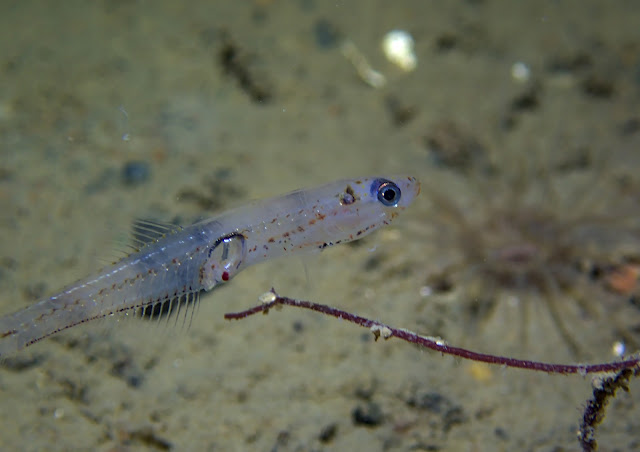
The Transparent goby (Aphia minuta) is very common, yet hard to photograph

Monday, 27 September 2021

Fossen 26/9 2021 One last dive for the season.

 Hi and ho!

This weekend I am once again back in Sweden to my regular haunts in Gullmarsfjorden. We decided to go to the Fossen dive spot, as they were about to close for the season, thus cutting off access to the dive site until April next year. But it matters not, there are several other dive spots that are open for divers year round in the area around.

A small Orange-clubbed sea slug on a piece of fallen down algae.

Dive 1

Depth 30m, Time :54 min, Temp: 14 C

Me and my buddy swam out to the left side of the bay before starting to descend close to the cliff wall there. We had heard from other divers at the site that today was a bit on the silty side, which we discovered was the case indeed. We followed the wall downwards and towards the left, not seeing much bottom, so there still remain some questions of exactly how deep it is, though the nautical chart tells that there is an area that exceeds 40 m right around there. Either way, we swam along the wall, photographing as we went, though I was having problems with my gear for a little bit, as I had forgotten to lubricate the o-rings of my trigger on my camera housing, so it got stuck a few times before it loosened up, which ruined a few photos. After about 24 minutes, my buddy signalled that it was time to start heading back towards the starting point, so we ascended a bit to shallower depth and began the swim back. We surfaced at 54 minutes, got up from the water and prepared to have a nice surface interval in the sun.


Leopard goby, a fish you usually don't catch out in the open like this.

Dive 2: 

Depth 30m, Time :44 min, Temp: 14 C

After about 1 h of surface interval in the sun, we once again made ready to head into the water. Me and my buddy took to the left side once more in order to try and explore the wall even further. We swam out a bit further before starting to descend this time, the waters were still rather turbid, with a very distinct halocline (no thermocline to speak of though). We swam along the wall, photographing as we went, and this time my camera housing did not act up :)

During this dive I observed that there was quite a lot of White sea urchins on the wall from 28 m and below. After about 20 minutes, my buddy signalled that it was time to turn around, so we once again ascended to a shallower depth and started making our way back to the starting point. Above the cliff walls, it was sort of a sloping soft sand/mud bottom with many hermit crabs scuttling about.

We surfaced at 44 minutes, and thus ended the last Fossen dive for the season.

All in all, it was a nice dive day, though the visibility could have been better, but it was a very clear halocline for this time of the year.

So until next time! Keep on Swimming!


A large Dahlia anemone found in a crevice on the cliff.


Thursday, 23 September 2021

15/9-18/9 2021. A trip to Flekkefjord, Norway with Chalmers diving club.

 Hi and ho!

Now that our dear neighbour to the west, Norway, has opened their border after a year of plague and uncertainty, my club decided that now was a good time to take up the tradition of doing a longer dive trip to Norway, as the diving there is in a completely different class compared to Sweden. Said and done, the destination of the trip was decided to be Flekkefjord on the south western coast of Norway, reasonably far away from home. There is also a historical wreck there, the wreck of Gudrun, a WW2 ship that is located just outside of Flekkefjord.


Urticina eques, a beautiful anemone closely related to the Dahlia anemone (and hard to differentiate)


Dive 1: Gudrun 1

Depth: 35 m, Time: 46 min, Temp 17 C

We anchored the boat onto the float that marks the position of the wreck of Gudrun. Decided upon dive pairs and headed off into the waters. All divers descended following the rope in quite the quick fashion as a group, almost too quick really as i got some problems with equalizing at 18 m and had to stop for a little bit to clear it, but as soon as that was done we kept going. Gudrun herself came into view at about 20 m, meaning that there was about 7 m visibility straight down on this day. We came down on the rear of the wreck and all swam up to the big steering wheel in order to get the obligatory photos while posing with it. After photos were snapped, we split up into the decided buddy pairs and me and my buddy began swimming around the wreck, looking at the rudder, propeller and all the other things she had to offer. As Gudrun lies quite deep, me and my buddy didn't have that much time on her, even with the best gas mix for the depth we were on. So after a little while, we started to run low on time before deco, so we started swimming back to the rope in the rear and started ascending along it. In order to stretch out the dive as much as possible, I decided to ascend as slowly as humanly possible (and so i could try and photograph the critters on the rope too) As we were slowly making our way up, we started to see the second dive pair further down underneath us, but soon they also were at about the same depth as us at the safety stop. We surfaced at 46 minutes, got up in the boat and got ready for surface interval.


Star ascidian (Botryllus schlosseri), a colonial sea squirt

Dive 2: Torsøy

Depth: 10 m, Time: 65 min, Temp 17 C

The second dive of the day was decided to be closer to the Flekkefjord dive club house, as we had gotten out pretty late, nonetheless, we found a small bay relatively close to the starting point, parked the boat and got into the water. Here the bottom was quite similar to the type i am used to, muddy, with lots of smaller fish and decaying algae. Honestly this was quite a boring dive site, but nonetheless, me and my buddy kept swimming around. We surfaced at 65 minutes, got back into the boat about at the same time as the others, and drove home to the diving club house.


European painted top shell (Calliostoma zizyphinum)


Dive 3: Saueholmene

Depth: 28 m, Time: 62 min, Temp 17 C

We headed out to the outer parts of the archipelago, the weather was perfect, almost too perfect, with almost no waves out in the open and the sun shining brightly. We rolled into the water from the boat close to a cliff wall, swam closer by and started descending as soon as everyone was ready. When we descended, we discovered that this area was an area with plateau's on different levels and waving kelp forests. Though honestly i didn't get to enjoy it quite as much as my dive buddies kept swimming on like they were on some kind of schedule, or torpedoes trying to sink a boat or something. Either way, i was pretty ticked off by the time we ended the dive. Well, there was some pretty large fishes, mainly saithe swimming around in the kelp forest, which my buddies tried to hunt, but to no avail. We swam around for a while before we ascended to the surface, looking at the vibrant kelp forests and marine life.

We surfaced at 62 minutes, got into the boat and got ready to have a surface interval. while the other group did their dive.


Polymastia boletiformis A type of sponge.


Dive 4: Hunden

Depth: 23 m, Time: 39 min, Temp 17 C

After a surface interval we went to a place the other group had dived the day before, a small rock called Hunden (meaning "the dog") that jutted up right outside a bigger island. From the day before we knew this was an area where you could find and pick scallops. So we did some shifting around in the dive pairs and headed off into the water as the first dive pair. We swam on the surface until we got close enough to the small island that is Hunden. before we started to descend. The visibility on this dive was pretty ok still, though there was some particles in the water here. As we swam along, one of my buddies signal me to look at something, after looking a little bit, i realize it is a small Monkfish that is hiding in the sand. So i of course went up to it and started snapping photos for a bit. After i was done, we continued along the cliff and started to head a bit downwards. As we swam along the cliff wall, i was photographing some sponges when i spot a very pretty sea anemone a bit further away, when i get closer, i see that it is a Horseman anemone, and a beautiful one at that. So i excitedly began photographing it before letting the others close to it (as it usually is with me and photographing)

It was around here one of my buddies started to signal that they were running low on gas, so we began ascending shortly afterwards. At the safety stop, the first buddy tried to shoot their SMB, but the line had somehow gotten tangled, so i got to do it instead, this time it went pretty well :)

We surfaced at 39 minutes and swam back to the boat


European monkfish (Lophius piscatorius), though a very small specimen

Dive 5: Gudrun

Depth: 34 m, Time: 31 min, Temp 17 C

Once again we decided to do a dive on Gudrun, this time however, me and my buddy knew we had much less time on the wreck due to not being able to fill nitrox. We rolled into the water and quickly descended along the rope. down to the rear of the wreck. This time both me and my buddy got photographed with the big steering wheel, even though the photo of me did end up blurrier than the rest, oh well. After getting our photos snapped, one in the other buddy pair spotted a sizeable Lumpsucker in a crevide on the wreck, so i spent some time photographing that one before we split off from the other pair for our own dive. Me and my buddy swam around the rear of the wreck for a bit, even dipping down to the propeller before it was time to swim back along the surface line as we were running low on no deco time. We ascended slowly along the line and surfaced at 31 minutes. Got back into the boat and doffed our gear, getting ready for a surface interval with lunch.

Lumpsucker (Cyclopterus lumpus) trying to hide away from the camera (and the camera man)


Dive 6: Kålesundet

Depth: 30 m, Time: 28 min, Temp 17 C

The last dive of the trip was to a "unknown" 1700s wreck where there were some really large cannons spread out in the area. But as the exact position was unknown to us, we looked through the sea maps and position data on the internet and buoyed a spot where we thought was "appropriate" for this dive. Me and my buddy were the first pair in the water, we followed the buoy line downwards, but sort of lost it at 15 m depht due to various stuff, we did find it quite soon afterwards either way when we got a bit deeper. When we found the line again, we started seeing weird shapes a bit further way, when we swam closer, we realized that "holy guacamole! these be the cannons!" So we had managed to buoy the spot almost perfectly, we thus swam along the bottom looking at the cannons of the wreck, where they lay on the bottom, some being stuck in a upright position, others laying flat on the bottom among the rocks. At one, my buddy waved at me to come and look at something, that something turned out to be a medium sized lobster hiding underneath the cannon. I of course spent some time photographing it as i usually do. When i was done we continued on, albeit in the opposite direction, and soon afterwards, my buddy signalled that they were running low on gas. As we started to ascend, i realized there was quite the current going at about 10 m depth, so we were swept along for a bit. We surfaced at 28 minutes and got back into the boat in a orderly fashion, doffed our gear and got ready to be on boat watch as the other divers went diving (this was an area where we couldn't anchor).

All in all, it was a super nice dive trip, with almost perfect conditions.

So until next time! Keep on swimming!


Opening to one of the 1700s cannons on the bottom, this was the first of many.


Monday, 24 May 2021

Släggö 23/5 2021 Jellyfish season has started

 Hi and ho!

Due to the weather forecast once more telling of bad weather this weekend, me and my buddies decided to go to a site with a roof over the changing area. As we also had a newer diver with us this time, we decided to go to Släggö, as this is a site that is easy to dive. When we arrived at Släggö, the rain was pouring down, but soon it started to subside, which was quite nice.

We set up our gear, divided into pairs and got ready for the dives.

Vibrant male of Common dragonet, truly one of the prettiest fishes on the Swedish west coast

Dive 1:

Depth 27m, Time: 57 min, Temp: 9 °C

Me and my buddy jumped in and started swimming out from the pier before we deemed it far enough to do a descent. As we descended in a orderly fashion, we saw directly that there was a lot of jellyfish in the water, signalling that the jellyfish season had come. When we got a bit further, my buddy signalled that they were having problems equalizing, so we stayed at a certain depth for a bit as they equalized their ears. After they managed to get their ears equalized, we continued further down. at 11 m, we encountered a thermo-and halocline, where the waters suddenly got quite a bit colder. We followed the bottom, along the cliff and out over the soft bottom, finding the dive helmet once more. As we were nearing our NDL, my buddy signalled me to look at something, turned out to be a rather large male Common dragonet. I stopped to take some photos of it before signalling that we were to ascend and turn around, as the NDL had gotten pretty low, and that it was time to start swimming back. When we reached about 12 m depth on the way back, I looked around a little bit and saw that there was a veritable minefield of lion's mane jellies above us, which made me a bit concerned. As we were swimming back, we met the other buddy pair that was with us this day on the way out, turned out they had some weighting problems for the new person and thus took a while to get ready. 

We surfaced at 57 minutes and got up to prepare for a nice surface intervall. At this point it had stopped raining too.


Moon jellyfish (Aurelia aurita) swimming into the light beam of my buddy.

Dive 2:

Depth 27m, Time: 56 min, Temp: 9 °C

After a nice surface interval with pizza and relaxing, it was time for the second dive of the day. Me and my buddy swam out once more and descended close to the cliff. This dive the goal was to look for European lobsters, which meant we were to look among the rubble and in the crevices near the cliffs. We continued in a orderly fashion, descending while following the walls, looking in the crevices and underneath the rocks. The first lobster was really shy, and didn't quite show itself, with only the claws slightly visible from underneath the rock, I tried to just hang about for a bit, to wait it out, but that didn't work, so we continued further. The second lobster was one of heftier size, hiding away inside a crevice close to the deeper parts.

At about 25 minutes we turned around, as I deemed it appropriate to turn around at this time frame, we swam back, gas was starting to get to lower levels too, and I felt like i didn't want too much of a surface swim back (though it was ok really, just making sure that we had some gas to spare on the way back, as a safety thing). We surfaced at 56 minutes, got up and out of our gear, and prepared to go home after a nice dive day.


All in all, it was sure a nice day for diving, even if it began a bit on the wet side.

So until next time! Keep on swimming!
Lion's mane jellyfish, got my buddy to backlight this one, so we got this motif


Sunday, 28 March 2021

Ormestad 27/3 2021. Mud and clear waters.

Hi and ho!

This weekend, me and my buddies decided to go dive in the Gullmar fjord, as we reasoned that the ice cover that had been there due to the cold-snap in January to February had to be gone by now. Said and done, we decided that the site of the day was to be Ormestad, the best wall diving spot in the area. Due to rain and melting ground frost, ice and snow, the ground in the area was very soft and muddy (so muddy that we in fact got stuck for a while when we were leaving the site later at night). So, we parked our car, carried our dive gear to the wood pier in the area and geared up for the dive.
Bobtail squid resting on the bottom


Dive 1:
Depth 26 m, Time: 43 min, Temp: 5 °C

We waded out into the water and started swimming towards the cliff on the left side of the bay, as to reach the main attraction of Ormestad, the vertical wall that extends from the surface and down to 90m depth. When we reached the wall we started to descend, following the wall down to an appropriate depth and outwards with the wall to our left. As we descended, we realized that the surface had rather bad visibility, which cleared up after about 5 m, going from 2 m visibility to about 7-10m. On the wall, it was full of sessile organisms like tube worms, sea anemones and sea squirts of different kind. After a little while, it became time to turn around as I hit turn pressure in my tanks. So that we did. At 43 minutes, we surfaced and started to swim back to the wood pier from where we started. During this dive I was testing out the new camera housing trigger (in reality a old one from my previous camera house, the one on my current camera housing broke last week), which worked pretty well, just took a bit more force to take photos.
After we got up, we had a bit of a surface intervall before getting ready for the next dives.


Dive 2:
Tall sea pen, one among many
Depth 28 m, Time 37 min, Temp: 5 °C

After having a surface intervall, we got ready to get into the water, I almost didn't do the dive, as my stomach was feeling like it was acting up a little bit. But soon it calmed down, and I got ready to dive in a jiffy. This dive, we went towards the right side of Ormestad instead, where there is a muddy slope instead of a vertical wall. We followed the slope downwards, looking at (and in my case, photographing) the critters that showed up here. At about 24 m depth, we hit a rather nice "forest" of Tall sea pen, which I stayed around to try and photograph a little bit. After we left the forest, we encountered a bobtail squid resting on the sea floor, which I of course had to photograph as well. Around this time the no deco limit time was starting to run low, so we had to start swimming upwards again. We surfaced at 37 minutes and swam back to shore.


All in all, it was a nice dive day, even if we did get stuck in the mud with the car as we were leaving. 

So until next time! Keep on swimming! 


Rugose squat lobster hiding in crevice 

Monday, 30 November 2020

Jordfall 28/11 2020. Rebreathers, Rays and Rime

Hi and ho!

Common dragonet in front of a Spiny Starfish

This weekend, we got the first real winter temperatures, with below 0 °C temperatures in the air, yet we braved these conditions and went out to go diving. We had decided upon Jordfall, as this is a easy spot, and we were honestly feeling a bit lazy. Said and done, we got to the site, after some "but's" and "if's", assembled our gear and kitted up for the first dive of the day.

Bobtail hiding in the sediment, can't tell which species though
Dive 1
Depth: 27 m, Time: 45 min, Temp: 11 °C

Me and my buddy swam out to the end of the jetty before we started to descend. We had spoke to some divers that had been in the water earlier, and they told us that the visibility was "very bad", but when we started to descend, it turned out to be the rather normal for the area and time of the year. When we got visual contact wit the seafloor, I almost immediately saw two Common dragonets hanging around, unfortunately, one was in a bad position, so I could only photograph the other one.
After photographing the dragonet for a little bit, me and my buddy began following the bottom downwards and outwards on the mud bottom, looking for various stuff. At about 25 m, i spot a little something sticking up in the mud. With a closer look, it turned out to be a larger bobtail squid, very likely a Rossia. sp. So I spent a bit of time photographing it from various angles, when I finally decided that it was enough, it was about time to turn upwards, as no-deco time was running low. So I signalled to my buddy that it was time to turn around and swim upwards, so that we did. As we got close to the cliff wall of  Jordfall, I was hitting turn pressure, so we began swimming back. It was at this point I spotted a small shape close to the cliff wall, turned out to be another bobtail squid, so I was spending some time photographing it before continuing to swim back towards the starting point.

We surfaced at 45 min, got onto land and got ready for a surface intervall.


Sand goby, a small goby that likes to hang out on sandy bottom, hence the name


Dive 2
Depth: 30 m, Time: 35 min, Temp: 11 °C

After a surface intervall, most of us were feeling too cold for a second dive, however, me and another of my buddies were up for one, so we went in. This buddy had gone and got themselves a fancy machine, a Poseidon Rebreather, so they were testing it out this day. We swam out to the end of the jetty once more, and descended into the darkness. When we got visual contact with the bottom, we started swimming outwards following the bottom. After a while, my buddy suddenly signalled that they were seeing something, as i got closer, I see that it is a skate, so we spent a good while hanging around it, while I was photographing it and my buddy was just looking at it. After a while, the skate had enough of us, and we left it alone. The rest of this dive was rather uneventful, as nothing could really top the skate.
We ended the dive at 35 minutes, got up and got ready to head back home.

All in all, it was a nice dive day, with the highlight being the skate

So until next time! Keep on swimming!


Close up of the skate, can't really tell which species though

Monday, 16 November 2020

Skår 14/11 2020, Troubles and bubbles.

Hi and ho!

As the autumn is going strong, the days are getting shorter and shorter, meaning night diving is getting easier and easier to do. So, this week me and my buddies decided to shift things around a bit and go to a site we don't go to as often for some reason. The diving spot of this weekend was decided to be Skår, the site furthest out in the fjord of our dive spots. We arrived at the dive spot and met up with our other friends that was to dive with us, got our gear out and set up, divided into buddy pairs and set out for the first dive of the evening.


The North sea tube anemone, a common species on the soft bottoms.
Dive 1:
Depth: 27 m, Time: 44 min, Temp: 11 °C

We waded out in the water until we were about waist deep, at which point, we donned our scuba fins and started swimming out until we reached a point where we couldn't see the bottom anymore. We began descending, and that is where the first troubles started. My buddy had problems descending, but after a little while they managed to start sinking. We descended in a relaxed fashion, signalled "OK" when getting visual of the bottom and started swimming to the right, following the slope and the walls. As we were swimming, and I photographing, my main light started to act up, blinking and dimming randomly, sometimes turning itself off, a problem that persisted throughout the dives, I had to fiddle with that every now and then. When we hit turning pressure, we turned around and began going more shallow and back towards the starting point. At about 20 m, while I was photographing something, my buddy signalled that something was wrong. I looked up and saw that they were starting to float upwards, what ensued was a quick session of dragging down and stabilizing, before I signaled that we were ending the dive by going upwards following the bottom. We continued swimming upwards, while I kept a somewhat closer eye on my buddy. At about 10 m, my buddy started floating upwards again, so I grabbed them while they were looking for a rock to hold onto, as to not float up again, after we found a suitable rock, we leisurely swam upwards to our safety stop and stayed there for the 3 minutes a regular safety stop takes. We ended as soon as the safety stop was done and surfaced. At the surface we did a quick analysis of what went wrong, and came to the conclusion that my buddy had changed to another kind of undersuit, which messed up their buoyancy. We swam onto shore, got up and got ready for a nice surface intervall.

Angular crab ready for a fight
Dive 2:
Depth: 30 m, Time: 38 min, Temp: 11 °C

After a surface intervall with discussions and coffee, me and my buddy got ready for the second dive of the evening. This time, my buddy had added 2 kg of lead to their system, which made the descent much easier this time. We swam out and started descending almost immediately after making sure everything was OK (well except my light that is). After getting visual of the seafloor, we started following the slope downwards and to the right once more, this time going slightly deeper than the earlier dive. As we were swimming, the second dive pair signalled us to come and look at something. Turns out that something was a Norway lobster hiding in it's burrow in the soft bottom, however, due to to my lamp acting up, I could not photograph this one. Soon after this, we started to near the NDL, so in order to keep somewhat better margins, me and my buddy ascended a few meters before we continued to follow the walls and slopes. As we were swimming, my buddy signalled me that they saw something, I turn my head, and behold, there was an Angular crab sitting on the cliff wall right beside me, so I started photographing this specific individual. After i felt I was done, we continued until we hit turn pressure and turned around. We swam upwards following the slopes and soon hit the safety stop. While laying on the safety stop, I spent some time photographing a Baltic prawn that had come wandering into my line of sight. We ended the dive soon after and got up, turns out I had navigated rather wrong, and we were a bit further from the landing point than I thought.

All in all, it was a nice night diving evening, even if  I have realized that I need to buy a new dive light very very soon.

So until next time! Keep on Swimming!


Baltic prawn out and about on the sand at night.

Monday, 2 November 2020

Jordfall 31/10 2020. Two more for the list

Hi and ho!

This weekend we once again decided upon doing some night dives, and as usual, the site was decided upon on the way to the sites. Once again it was decided to be in the Jordfall marina, as one of us was there doing their dive master examination, which fit us rather well. Said and done, we arrived at the site late in the afternoon with food and drinks for our buddy at the site, got our gear out and started preparing for the dives. After setting up, we divided into pairs, made our dive plans, geared up and started to get into the water.

Close up of a squat lobster, look how beautiful the colours are.

Dive 1:
Depth: 31 m, Time: 36 min, Temperature: 11°C

Me and my buddy got into the water and swam out to the end of the jetty before we started descending. Like the week before, the surface waters were somewhat brown due to the freshwater flow from land bringing humus into the top layer, but as soon as we got underneath it, the vis cleared up much more. We immediately started following the slope downwards in order to search for squid. As we were swimming downwards, I spot something peculiar at the edge of my light cone, as I got closer I realized it was a crab, and a species I've never seen before. So I started photographing it, unfortunately it was very skittish and started running as soon as I got closer, meaning that there was no close up photo of this one. Later when I had gotten home and had access to my books and sources, I found out that what I saw was an Angular crab (Goneplax rhomboides), a species that is recently immigrated to Swedish waters.
After leaving the crab be, me and my buddy continued our dive, looking for squids and other creatures, but no squids were to be found in the deep this time. After a while, it became time for us to start ascending, as we were both getting low on No Deco Limit time and gas, so we followed the bottom upwards again. As we were starting to come more shallow, with our NDL and gas still good, we decided to start swimming towards the left, and so we did until we found the cliff wall and boulders, there we spent some time looking into the crevices for various creatures, as I was photographing a crab, my buddy started signalling that they were seeing something, as I took a look, I first did not see anything, but after a few seconds of looking, lo and behold! A squid!, so I spent some time there, photographing the critter before I decided that I had harassed it enough and let it be. We ended the dive soon after, as we decided that it was simply time to get up for a nice thermos of hot beverage. Said and done, we got up, took off our dive packages and began discussing the things we had seen during the dive over some hot coffee.

The Angular crab is a species new to the area, the first records of it are from 2008


Dive 2:
Depth: 22 m, Time: 44 min, Temperature: 11°C

After a surface intervall with discussions and warm beverages, we once again got into the water for another dive. This time we went down in the same spot as before, however we started swimming left quite quickly, finding the walls early. We followed the walls during this dive, keeping on average above 20 m. As we were swimming around, I spot a shape close to the bottom, which turned out to be another squid, so we spent some time around the squid as I photographed it. After a while, it became time to turn around as we had been in the water for a while now, meaning that we needed some time to get back to the starting point as well. As we were nearing the end point, I was taking a closer look on some rocks when I spotted a small shape on top of one of them, turned out to be an Bryer's Nut crab (Ebalia tumefacta), a miniscule species of crab that I've never seen before as well, so that one got photographed as well :)
We ended the dive at 44 minutes as we simply had gotten so shallow that i thought it wasn't worth prolonging the dive anymore by then.

All in all, it was a super duper dive day, especially since I got to see two species I've never seen before, as well as squids, always love seeing them squids :)

Bryer's nut crab, a species about the size of a pinky finger nail, thus making it easily overlooked

So until next time! Keep on Swimming!

Love the Common bobtail squids, they are so cute when they dig down into the bottom like this

Monday, 26 October 2020

Jordfall 24/10 2020. Do you want to do a night dive?

Hi and ho!

Black goby looking a bit unhappy with my photographing

This weekend marked the first night dive of the 2020 autumn-winter season, as well as the end of a long surface intervall for one of my dive buddies. We decided on the way to the Gullmar fjord that we were to go to the Jordfall marina, as it is a easy and good spot for night diving in the Gullmar area. This time around, we had some not so experienced divers with us, which is another reason to choose Jordfall, as it is quite safe to dive there, no sudden drop offs like Ormestad :)

We got to the site in the evening and started to set up our gear, we also did a short dive site presentation and then divided us into pairs and got ready to head into the waters.

Luminecent sea pen, a beautiful creature like always


Dive 1: 
Depth 24 m, Time: 50 min, Temp: 12 °C

Me and my buddy swam out to the cliff, as we had planned to follow the wall during this dive. When we got to the corner of the cliff wall, we signalled to the surface personell and went down. It soon became clear that there was a lid of freshwater which blocked the last rays of the sun from going deeper, meaning that it was like a night dive to begin with. We descended close to  the wall and kept following it down and outwards in the regular way one does in Jordfall. As it was much darker in the water at this time, the marine life was much less shy and let itself be photographed somewhat, which is pretty nice when one loves nature photographing like I do.
We spent some time swimming around, looking at the different things that were out and about by this time before it was time to turn around and go back to the starting point. As we were nearing our safety stop, my buddy suddenly started to cork, which I was kind of expecting, as they had told me beforehand that they have problems with their bouyancy in the end. but alas I could not stop the corking, so we both corked up to the surface with about 2 minutes of safety stop left, which is not quite OK, but not too bad either. We got up to land and doffed our packages for changing tanks.


The harbour crab with it's vivid blue hindleg paddles.

Dive 2: 
Depth 31 m, Time: 37 min, Temp: 12 °C

After a surface intervall with some coffee and talking about the first dive, me and my buddy got ready for the second dive of the evening. This time around, the plan was to go deep and over the soft bottom in order to search for squids, as it had been dark for a while now. Said and done, we swam out to the outermost part of the jetty before signalling to the surface personell and starting to descend. 
When we could see the bottom, we started to follow the slope downwards towards the depth, Looking and photographing as we went. During this dive, i showed my buddy what one can do with the Sea Pen Pennatula phosphorea in the dark. As we swam around, i saw something small over the bottom, lo and behold, a squid, so we spent a few minutes looking at, and photographing the little critter before it was time to go upwards again due to the NDL starting to run low.
We continued upwards in a orderly fashion and ended the dive at a bit of a shorter time than usual, but as it is starting to get colder in the water, it is to be expected tbh

All in all it was a nice dive trip, and a very successful first proper night dive for the season.


So until next time! Keep on swimming!
The highlight of this dive trip, a Common bobtail squid digging down into the mud.

Monday, 15 June 2020

Jordfall 13/6 2020. Summer heat and leaky neck seals

Hi and ho! 

 This weekend the weather was very much "summer", with high temperatures and clear skies. So me and my buddies decided it was a good time to go out and dive, even if the temperatures in the air was less than ideal for dry suit diving. We also brought with us some newer divers and prospective future buddies.

We went to the Jordfall Marina, as it is easy to get in and out, as well as very short distance between parking and diving. Kitted up and prepared to enter the water.
A truly magnificent specimen of Spiny Starfish.

Dive 1: 
Depth: 16 m, Time: 13 min, Temp: 10 °C

Devonshire cup coral, a small unassuming species that is rather common
As we entered the waters, the cooler temperatures was a welcome respite from the sweltering heat of the air (ok, not that warm, only 26 C in the sun, but it is rather steamy in a drysuit, especially a black one).
We swam out to the cliffs and descended in a orderly fashion. Unfortunately, the dive had to be cut short due to a very leaky neck ring on one of my buddies, so we preformed a free ascent as they were shivering very much. No photos were taken during this dive due to this.
As we got up on land and took a look, it became clear that the neck ring wasn't glued on properly and there was a huge gap, resulting in water flowing into the suit. But such things are fixable 😅

So we took a small surface intervall and waited for the other pair, while my buddy was warming up and trying to dry in the sun.


Dive 2:
Depth: 23 m, Time: 45 min, Temp: 10 °C

Harbour swimming crab, a species hard to photograph due to being skittish
After a short surface interval and changing dive tanks, we decided to go for the second dive. The plan was as before, a max depth of around 20 m, and follow the wall outwards. Said and done, me and my buddy descended in a orderly fashion and followed the wall out. When we descended i discovered that my camera lens had fogged up due to the 16 ° C difference between the water and the air. So the first part of the dive, i couldn't really photograph anything. After a while, the fogging had cleared up, and i could photograph again, which i did.
On this dive, we saw lot's of hydroids, sea anemones and swimming crabs and fish of different kinds, As we got more shallow there was a increase in both gobies and nudibranches.


All in all, it was a very nice dive day, temperatures and other stuff nonwhitstanding.


So until next time! Keep on Swimming 😀

The very common Orange-Brown aeolid :)